Practical ESG, Sustainability & Packaging Compliance for Irish SMEs.
TrailZero takes the “Green Tape” off your desk; simplifying compliance, reducing waste costs, and giving you more time to grow your business.
Book a free, no obligation consultation, and see how TrailZero can help your business!
ESG used to be something only large companies worried about. Not any more.
Irish businesses that make or sell physical products are now receiving sustainability questionnaires from their biggest customers, being asked for ESG data by their banks, facing EU packaging compliance deadlines, and losing tenders because they don't have the right documentation in place.
Most don't have the time, the in-house expertise, or the budget for a big consultancy. TrailZero exists to close that gap, practically, affordably, and without the jargon. Our mission is to help empower SMEs to participate in the green economy and achieve measurable success through sustainable business practices. All engagements are handled personally by the founder.
Services
TraIlZero is a specialist advisory service for Irish SMEs in food, drink, manufacturing, and consumer goods, helping you respond to what's being asked of you right now, and build the evidence file that protects you for what's coming next. For a detailed overview of our services, see our Services & Pricing page.
ESG Consulting & Supply Chain Support
Packaging & PPWR Compliance
VSME & Sustainability Reporting
Green Finance & Tender Support
Carbon Footprinting
Packaging & Resource Efficiency
Energy Efficiency
ESG Data & Questionnaires
The Benefits To You
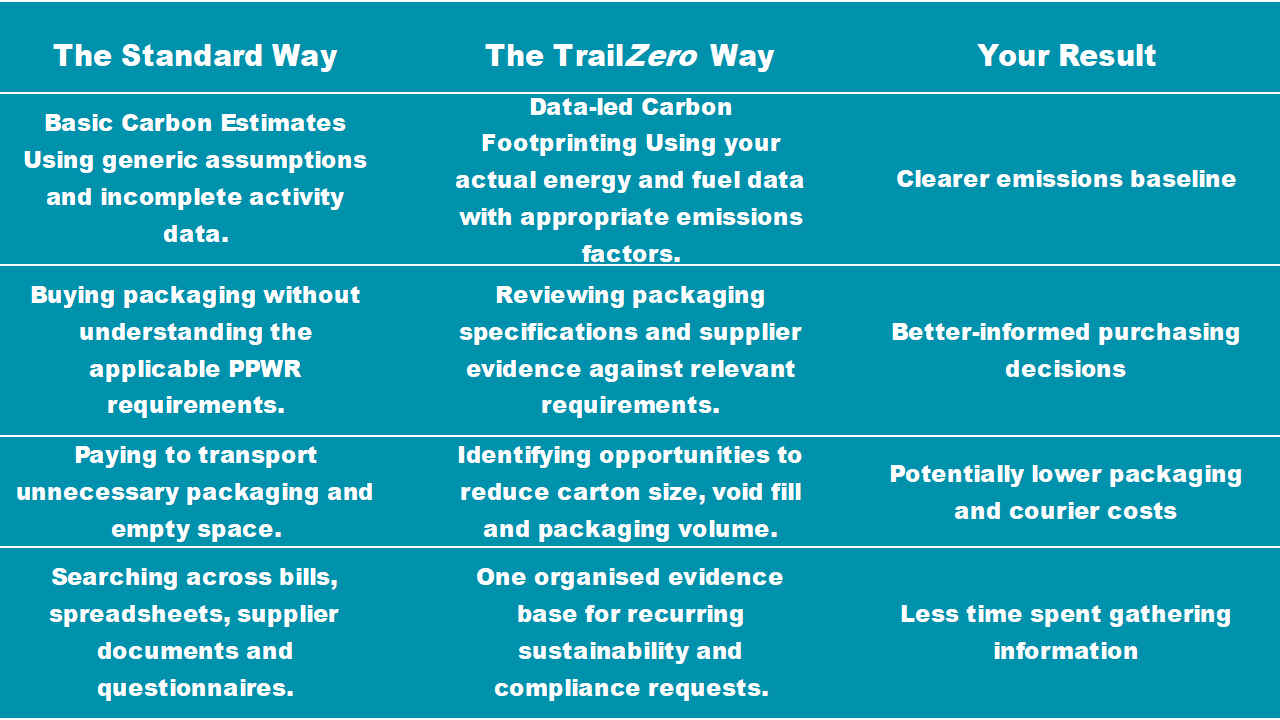
Improve ROI & Efficiency: Reduce shipping costs, packaging and energy waste, and identify opportunities for more efficient operations.
Customer & Bank De-Risking: Respond confidently to sustainability and compliance requests from customers, lenders and supply chains.
Defensible Compliance: Build structured evidence for applicable PPWR requirements, including packaging documentation and relevant minimization requirements.
Accurate Carbon Footprinting: Build a documented carbon footprint using recognized methodologies and appropriate emissions factors.
Zeroing the Data & Admin Burden: We organize the data and documentation so you can focus on running your business.
How It Works
Simple, straightforward, no surprises.
Step 1
Tell us what you need
Get in touch with a brief description of your situation; a customer questionnaire, a packaging deadline, a finance application. We'll have a short call to understand what's needed and confirm whether we're the right fit.
Step 2
We do the work
Once agreed, we handle the heavy lifting. We collect your data, assess your packaging, review supplier documentation, or build your ESG profile, keeping you informed without overwhelming you with detail. You review and sign off before anything goes to a third party.
Step 3
You get something you keep
Every engagement produces a reusable evidence file for your business, whether that's an ESG data file, a set of assessment outputs, a VSME sustainability report, or a tender pack.
Built for Irish businesses in the right situation.
We work best with Irish businesses that make or sell physical products in food and drink, manufacturing, consumer goods, cosmetics, or packaging. Our typical clients consist of both SMEs and Micro Enterprises, employing anywhere up to 200+ people, supplying into larger companies or retail chains, and is starting to feel the pressure of ESG and regulatory demands that they don't have the internal resource to handle.
If any of the following sounds familiar, you're in the right place:
• A customer has sent you a sustainability or ESG questionnaire from EcoVadis, CDP, or a bespoke buyer form, and you don't know where to start.
• Your bank or a funding body has asked for ESG data as part of a finance application and you have no documentation to provide.
• You've seen an ESG or sustainability section in a tender and left it mostly blank.
• You're selling packaged products into the EU and haven't started thinking about the PPWR requirements that now apply.
• Your packaging supplier has told you they're "PFAS-compliant" but can't provide the supporting compliance documentation.
• You know ESG is becoming important but don't know where to start or what actually needs to be done.
Questions Usually Asked
-
Short Answer: Potentially, yes.
The PPWR applies to packaging and packaged products placed on the EU market, and the responsibilities of a business depend on its role in the packaging supply chain. You do not have to manufacture packaging yourself to have obligations under the Regulation.
For example, businesses may have responsibilities as a manufacturer, importer, distributor or producer, depending on what they do and how the packaging is placed on the market. The European Commission's guidance specifically distinguishes the roles of manufacturer and producer, and an importer or distributor can also be treated as a manufacturer in certain circumstances, such as where packaging is placed on the market under its own name or trademark or is modified in a way that could affect compliance.
TrailZero helps SMEs understand which requirements are relevant to their particular role and reviews the packaging documentation and evidence they may need to support compliance.
-
Short Answer: Not necessarily, but a supplier statement on its own may not provide enough evidence.
A statement such as "PFAS-Free" or "PFAS not intentionally added" can be useful, but businesses should understand exactly what the statement covers and whether it relates to the specific packaging they are placing on the market.
From 12 August 2026, the PPWR restricts PFAS in food-contact packaging above specified limits, including 25 ppb for any individual PFAS, 250 ppb for the sum of targeted PFAS, and 50 ppm for PFAS including polymeric PFAS. Where total fluorine exceeds 50 mg/kg, the PPWR also provides for evidence to be supplied, on request, showing whether the fluorine is present as PFAS or non-PFAS.
The PPWR also establishes a broader requirement to minimise substances of concern in packaging.
For SMEs, the practical issue is therefore not simply whether a supplier has written "PFAS-Free" on a document. It is whether the available evidence is sufficiently clear, current and linked to the relevant packaging product or SKU.
TrailZero can help businesses review supplier declarations and supporting packaging documentation, identify gaps and establish a structured evidence file for relevant PPWR and food-contact requirements.
-
Short Answer: No. The specific PFAS restriction is focused on food-contact packaging.
The PPWR's specific PFAS restriction applies to packaging that comes into contact with food and sets limits for specified PFAS concentrations. The broader PPWR also contains requirements concerning substances of concern, so businesses should not assume that the PFAS provision is the only relevant substances-related requirement.
Whether the PFAS restriction applies to a particular item depends on its intended use and whether it falls within the relevant food-contact packaging provisions.
TrailZero can help SMEs identify which packaging SKUs are potentially affected and review the available supplier and technical documentation.
-
Short Answer: It depends on when the packaging was placed on the market, not simply when it was manufactured or when it entered your warehouse.
The PPWR uses the legal concept of "placing on the market", meaning the first making available of packaging on the EU market.
For PFAS-containing food-contact packaging: the PPWR does not provide a general transitional period for stocks manufactured before 12 August 2026. However, the European Commission's guidance confirms that food-contact packaging placed on the market before 12 August 2026 may remain on the market and does not need to be withdrawn. Packaging placed on the market after 12 August 2026 must comply with the applicable PFAS limits, regardless of when it was manufactured.
This means that simply having packaging sitting in a warehouse on 12 August does not, by itself, determine whether it can continue to be used. The circumstances of how and when the packaging was placed on the EU market need to be considered.
For empty-space requirements, the specific 50% maximum empty-space ratio for grouped, transport and e-commerce packaging is a future requirement. The PPWR provides for this requirement from 1 January 2030, or three years after the relevant implementing act enters into force, whichever is later. The Commission has also confirmed that new empty-space limits are among the measures applying from 2030.
TrailZero Advice: Don't wait until packaging needs to be replaced before checking compliance. For high-volume food-contact packaging, review supplier documentation and relevant SKUs early so that you have time to address any compliance gaps, change suppliers or redesign packaging where necessary
-
The Short Answer: Yes, but your responsibilities depend on your role in the supply chain.
Under the PPWR, an importer established in the EU has specific responsibilities when placing packaging from outside the EU on the market. Importers must ensure that the packaging is compliant with the applicable PPWR requirements and, before placing it on the market, verify that the manufacturer's conformity assessment and required technical documentation have been completed and that the necessary documentation is available.
Importers can also become subject to the manufacturer's obligations where they place packaging on the market under their own name or trademark, or modify packaging already placed on the market in a way that could affect compliance. This is addressed specifically in Article 21 of the PPWR.
For packaging minimisation, the future 50% maximum empty-space ratio applies to economic operators that fill grouped, transport and e-commerce packaging. The requirement is scheduled for 1 January 2030, or three years after the relevant implementing act enters into force, whichever is later, with the Commission due to establish the calculation methodology by February 2028.
For an Irish importer, the practical message is therefore simple: don't assume your overseas supplier carries all of the compliance burden. You need to understand your role, obtain the relevant technical documentation and establish whether the packaging you are placing on the EU market meets the requirements that apply to it.
TrailZero helps Irish SMEs review imported packaging, supplier documentation and packaging specifications, identifying gaps and building a structured evidence base for PPWR compliance
-
The Short Answer: More than just the visible air around your product.
Under Article 24 of the PPWR, the future 50% empty-space ratio applies to grouped, transport and e-commerce packaging. The regulation defines empty space as the difference between the total volume of that packaging and the volume of the sales packaging contained within it.
Importantly, the regulation specifically treats space occupied by filling materials — including paper cuttings, air cushions, bubble wrap, sponge or foam fillers, wood wool and polystyrene — as empty space for the calculation.
The 50% maximum is due to apply by 1 January 2030, or three years after the relevant implementing act enters into force, whichever is later. The European Commission is required to establish the detailed calculation methodology by 12 February 2028. That methodology will take account of legitimate packaging needs, including product protection, irregularly shaped products, liquids, fragile products and the space needed for shipping labels.
This means businesses shouldn't wait until 2028 or 2030 to start reviewing packaging. Changes to packaging formats, suppliers and specifications can take time.
TrailZero can assess packaging dimensions and configurations, identify potential sources of excessive empty space and help businesses understand where packaging redesign or supplier changes may be worth considering ahead of the future requirements
-
The Short Answer: We help turn your operational data and supporting documentation into a structured evidence base for your VSME reporting.
VSME provides a voluntary framework for SMEs to report relevant sustainability information in a more structured and consistent way. It can also help businesses respond to information requests from larger customers, banks, investors and other stakeholders.
The quality of a sustainability report depends on the underlying information and evidence used to support it. TrailZero can help businesses gather, organise and assess relevant data and documentation.
For packaging and PFAS: We can review relevant packaging specifications, supplier declarations and available technical documentation, helping identify information gaps and providing supporting evidence that can inform relevant sustainability disclosures.
For PPWR and packaging efficiency: We can assess packaging data, material use and relevant empty-space considerations, helping identify opportunities for packaging reduction and resource efficiency. The resulting information can support relevant environmental disclosures and improvement initiatives within your VSME reporting.
For carbon footprinting: We can help establish a documented Scope 1 and Scope 2 carbon footprint using operational data and recognised methodologies, providing a useful evidence base for relevant climate-related information.
TrailZero's Value: We connect the practical information within your business; packaging, energy, emissions and operational data, with the structured sustainability information you may need for VSME reporting and customer or finance-related requests.
-
Short Answer: ESG may not be a mandatory reporting requirement for your business, but sustainability information can still matter commercially.
Many small and medium-sized businesses are outside the scope of mandatory EU sustainability reporting requirements. However, they may still receive requests for sustainability information from larger customers, financial institutions, investors or other business partners.
This is one of the reasons the EU introduced the Voluntary Sustainability Reporting Standard (VSME). The standard is designed to give non-listed SMEs a proportionate way to organize and communicate sustainability information, including information that may be requested by larger companies and financial institutions.
You therefore don't necessarily need a large ESG function or a lengthy sustainability report.
For many SMEs, the practical starting point is understanding and documenting areas such as:
energy and emissions;
packaging and resource use;
waste and environmental impacts;
workforce and social information; and
governance and business practices.
Having this information organized can make it easier to respond when a customer, lender or procurement team asks for sustainability information, and can also help identify opportunities to improve efficiency and reduce environmental impacts.
TrailZero helps Irish SMEs build practical sustainability information and supporting evidence, whether they need to respond to a customer questionnaire, prepare VSME reporting or develop a broader sustainability improvement plan.
-
Short Answer: Not necessarily.
Most SMEs outside the scope of mandatory sustainability reporting do not automatically need to produce a full ESG report. What you need depends on your business, your customers, your financing arrangements and the sustainability information being requested.
For some businesses, a structured set of ESG information and supporting evidence may be sufficient. Others may benefit from a formal VSME sustainability report, particularly where they regularly receive information requests from larger companies or financial institutions.
The European Commission's voluntary sustainability reporting standard is specifically intended to provide a proportionate framework for smaller companies outside mandatory reporting requirements and to help them respond to sustainability information requests.
TrailZero can help you determine what level of sustainability information is appropriate for your business rather than creating unnecessary reporting simply for the sake of it.
-
Short Answer: Not necessarily.
For many SMEs, establishing a reliable Scope 1 and Scope 2 baseline is a sensible starting point. Scope 1 covers direct emissions from sources owned or controlled by the business, while Scope 2 covers emissions associated with purchased energy.
Scope 3 covers other indirect emissions across the value chain and can be much more complex to calculate. Whether it is appropriate to assess Scope 3 will depend on the purpose of the footprint, the information available and what customers, lenders or other stakeholders are asking for.
TrailZero can help SMEs establish a proportionate carbon footprinting approach and identify where additional emissions information may be useful.
-
Short Answer: Yes. Starting from zero is fine.
Many SMEs have never systematically collected sustainability data before. You don't need to have an existing ESG reporting system in place before you start.
TrailZero can help you establish what information is already available within the business, identify what is missing and put a practical process in place for collecting the relevant information going forward.
This might include:
Energy and emissions: reviewing electricity, heating and fuel data and establishing a baseline where appropriate.
Packaging and materials: gathering packaging specifications, material information and supplier documentation.
Operational information: identifying relevant environmental, social and business-conduct information already held within the business.
Supporting evidence: organising the underlying documents, calculations and assumptions so that information can be traced and updated.
Future data collection: establishing a proportionate process for keeping the information up to date.
Where VSME reporting is appropriate, the objective isn't to collect every possible piece of ESG data. The VSME is designed to be proportionate to the size and circumstances of an SME, with a Basic Module and an optional Comprehensive Module.
For a business starting from scratch, the first year is therefore about establishing a credible baseline and a repeatable process. Subsequent reporting can then build on that information and improve over time.
TrailZero helps Irish SMEs turn the information they already have, and the information they need to start collecting, into a structured sustainability evidence base that can support VSME reporting, customer requests and future sustainability initiatives.
-
Short Answer: No.
Food and drink is an important focus for TrailZero because businesses in these sectors can face significant packaging, food-contact, supply-chain and sustainability requirements.
However, our services are not limited to food and drink. We also work with SMEs across areas such as:
manufacturing;
construction;
professional and business services;
facilities management; and
other sectors where sustainability, packaging or ESG information is becoming relevant.
The specific requirements will depend on your business, products, activities and supply-chain relationships. For example, an SME may be asked by a larger customer or financial institution for sustainability information, regardless of whether it operates in a packaging-intensive sector. The VSME framework is specifically designed to provide a proportionate approach for non-listed SMEs and to help them respond to sustainability information requests from larger companies and financial institutions.
TrailZero helps Irish SMEs identify the requirements relevant to their business and put practical sustainability, ESG and compliance information in place.
-
A one-off engagement is designed for a specific, immediate requirement, such as completing a sustainability questionnaire, preparing a VSME report, reviewing packaging documentation, carrying out a carbon footprint assessment, or preparing a tender response.
A retainer is designed for businesses that receive sustainability or compliance requests regularly and want ongoing support. This can include maintaining and updating their sustainability data and evidence base, responding to recurring customer or lender requests, reviewing new packaging documentation, and providing advice as requirements develop.
The benefit of a retainer is continuity. Your business has an established process and a familiar point of contact when a new request arrives, rather than starting from scratch each time.
TrailZero can structure either approach around the level of support your business actually needs.
-
Short Answer: Start with what you already have.
You don't need a sophisticated ESG system or years of historical sustainability data. Depending on the service, we may work with information such as:
energy bills and fuel records;
packaging specifications and supplier declarations;
purchasing or material data;
waste and operational information;
customer or lender questionnaires; and
existing sustainability policies or reports.
We'll identify what information is available, what is missing and what additional evidence may be required.
The aim is to build a practical and proportionate evidence base, rather than create unnecessary administration for your business.
TrailZero works with the information already available within your business and helps establish a practical process for collecting and maintaining what you need going forward.
-
Short Answer: No.
And any consultant who guarantees a particular outcome should be treated with caution. What TrailZero provides is accurate, well-supported and professionally prepared information designed to put your business in the strongest possible position.
The final outcome always rests with the customer, buyer, procurement team, lender or other decision-maker. TrailZero can help ensure that the information you provide is complete, consistent and supported by appropriate evidence, but we cannot guarantee the decision that follows.
About TrailZero
Michael Staunton is the founder and principal consultant at TrailZero. With a professional background in financial services and data-focused environments, he recognized a growing need for practical, affordable sustainability and packaging compliance support tailored specifically to Irish SMEs.
Combining ESG reporting and packaging knowledge with technical analysis expertise, Michael helps businesses navigate emerging EU requirements including PPWR, sustainability reporting expectations, and operational efficiency challenges. His approach focuses on clear, evidence-based assessments designed to identify practical compliance improvements, packaging reduction opportunities, and cost-saving efficiencies.
By operating through a remote-first consultancy model, TrailZero keeps overheads low, allowing services to remain accessible and cost-effective for SMEs while minimizing operational environmental impact.
Holder of an Executive MBA, Michael has a Diploma in ESG from the Corporate Governance Institute in Ireland, and a certificate in Sustainable Packaging in a Circular Economy from Delft University of Technology, Netherlands.

TrailZero | info@trailzero.ie | Based in the north-east, working remotely nationwide.
TrailZero Insights: What’s Changing?
PPWR: Now in Application Across the EU
The PPWR (Regulation (EU) 2025/40) has applied across the EU since 12 August 2026, with new requirements now beginning to take effect.
The “So What?”
Substances of concern limits, conformity documentation, and producer-responsibility duties are now enforceable, no further grace period.
The European Commission released a second, expanded FAQ on August 3, 2026, clarifying several areas manufacturer identification for unbranded transport packaging and post-application enforcement.
ESRS: Reporting Burden Cut by Over 60%
The Commission adopted revised European Sustainability Reporting Standards on 3 July 2026, reducing mandatory ESRS datapoints by more than 60%. The revised standards are now subject to scrutiny by the European Parliament and Council.
The “So What?”
Expected to cut reporting costs by over 30% per company once the Parliament/Council scrutiny period ends.
VSME: Voluntary Standard Adopted by Commission
Following February 2026's Omnibus I Directive, EFRAG has confirmed the Voluntary SME (VSME) standard delegated act is still expected around September 2026
The "So What?"
The European Commission adopted a voluntary sustainability reporting standard for smaller companies on 3 July 2026. The standard is designed to help SMEs respond to sustainability information requests from larger companies and financial institutions.
Let’s begin the conversation.
Not sure where to start? TrailZero is here to help. Every business is unique, and we want to ensure you find the solution that fits. Reach out with any questions, or if you're ready to get started, schedule a free consultation today.